Veterinary Dental Expert Reveals: The Top 3 Mistakes Keeping Your Cat's Gums Inflamed — And Walking Her Toward the Anesthetic She Doesn't Wake Up From

Most cat owners think red gums are a brushing problem.
They aren't. It's an immune reaction — and it starts in the gut, not the mouth.
Your cat's own white blood cells are attacking the plaque under her gumline at full force, because the gut bacteria that teach them to hold back have starved. Veterinary researchers have tracked this for twenty years.
And most owners are spending thousands on procedures that were never designed to reach it.
And every year it goes unaddressed, she is one dental closer to an anesthetic her body is less able to survive.
If any of these sound familiar:
- Red or swollen gums along the tooth line
- Breath that has turned sour or metallic
- A vet who has said the words “dental” or “extractions”
- Blood on a toy, a bowl, or when you press the gum
Then this article is about your cat.
The owners I see aren't careless. Most have already booked one dental, paid for it, and watched the gums come back red within the year. Because nobody ever told them the real cause.
Gum disease in cats begins in the gut, in a bacterial population no toothbrush can reach. Until that changes, nothing above the gumline holds.
There are three specific mistakes keeping most cats in that cycle. Once you see them, the fix becomes obvious.

1MASKING THE SYMPTOM INSTEAD OF FIXING THE CAUSE

Dental treats. Water additives. VOHC powders. Plaque gels.
These don't fix gum disease. They work on the surface of the tooth while the immune reaction continues underneath, unchanged.
The breath improves for a few hours. Then it comes back — usually worse.
What feels like “dental care” is letting the real problem accelerate unchecked.
Less smell doesn't mean calmer gums. It usually means the opposite.
And here's what most cat parents never hear: the inflammation doesn't stay in the mouth. It runs through the gum tissue into the bloodstream, every day, for years.
2WAITING FOR A $2,500 DENTAL TO FIX SOMETHING IT WAS NEVER DESIGNED TO FIX

Here's the cycle most cat parents get trapped in. See if it sounds familiar:
The vet sees red gums. You book the dental. General anesthesia, full intubation, pre-op bloodwork, X-rays under sedation because that's the only way to see below the gumline at all. You sign the consent form. You wait in the parking lot.
It costs two and a half thousand dollars. The gums look better for a season. Then they're red again, and you're being asked to put her under a second time.
By the time most vets recommend a dental, the bone that holds the teeth has been receding for years. A cleaning scrapes away what accumulated — it does nothing to the reaction that put it there.
A $2,500 dental is where you end up when prevention was never offered. It isn't a solution. It's a reset button on a process that starts again the same afternoon.
And she is older for every one. Anesthetic risk climbs with age — which is why many vets stop offering it once a cat is in her teens. Some owners are told she is no longer a candidate. Some hand her over for a routine cleaning and are called into a side room afterwards.
The real opportunity is earlier. Before the bone goes. Before anyone asks you to sign that form again.
3TREATING BRUSHING AS THE ONLY REAL SOLUTION (WHEN YOUR CAT WON'T LET YOU)

If you've tried brushing your cat's teeth and given up — you're not a bad owner. You're the majority.
She turns her head. She bites down. She hears the cabinet open and she's gone. “I'll lose an eye if I attempt to brush her teeth” is the most honest sentence in every forum thread on this.
That guilt is completely misdirected.
Brushing helps — when you can actually do it. But most cat parents can't. Not daily. Not well. Not on an animal that has already decided.
And here's the part nobody tells you: the owners who do manage it, every single day, still watch the gums stay inflamed. They brush the enamel. The reaction is happening under the gumline, where the brush has never once reached.
If brushing has never worked for your cat, that isn't a failure of effort. It's a failure of method. And the fix is something completely different.
⚠️ READ THIS BEFORE YOU BOOK ANOTHER DENTAL

If you're masking breath, fighting a toothbrush, or waiting on a cleaning, you're treating the symptom — not the cause.
The real issue is immunological.
Plaque builds under the gumline every day in every cat alive. White blood cells — your cat's own defenders — are sent to clear it. Whether they clear it calmly or burn the gum down with it depends entirely on where they were trained.
They are trained in the gut. By Lactobacillus, the good bacteria.
The problem?
In dogs this works. In humans this works. In cats, Lactobacillus starve — because processed cat food is full of corn and wheat fillers, and those fillers feed Clostridium, the bad bacteria, instead.
The bad bacteria take over. The good ones die off, silently, from kittenhood. And with too few left, nothing holds the defenders back.
That is periodontal disease. Not a hygiene failure — a smoke alarm that goes off every time you make toast.
This is where real dental support actually begins.

THE BREAKTHROUGH AFTER 20 YEARS OF VETERINARY RESEARCH
Dr. Kenji Sato, a veterinary scientist at Hokkaido University, spent twenty years proving which bacteria train the defenders — and exactly what those bacteria need to survive in a cat.
Not masking. Not scraping. Feeding the population that holds the reaction back.
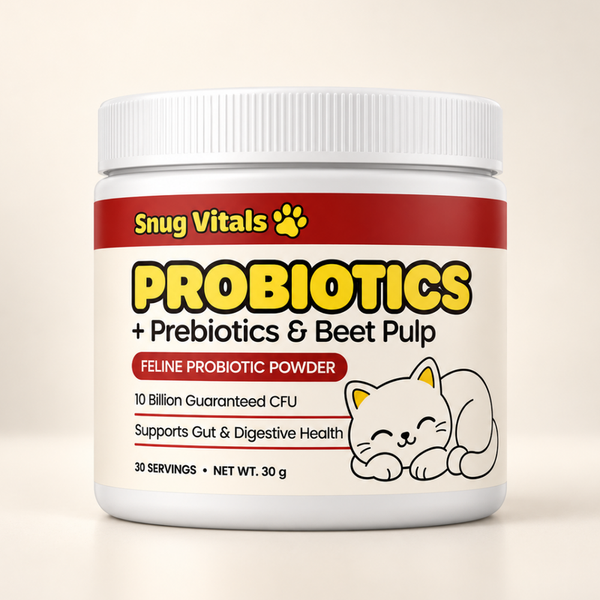
One scoop a day delivers:
- 10 billion live bacteria, three named strains — the population that trains the defenders to clear plaque without burning the gum.
- 500 mg GOS, the Japanese lab-made prebiotic from Dr. Sato's own study — the food Lactobacillus multiply on, so they don't starve within days.
- 200 mg beet pulp, the slower food that carries the feeding to the far end of the gut.
This is not symptom masking. It's the mechanism, in a form your cat's body can actually use.
Made only when you order, with extra bacteria added, so every scoop carries the full 10 billion.


THE RESULTS HAVE VETERINARIANS IMPRESSED
This isn't theory. It's measurable.
Feline studies on fed Lactobacillus populations showed the defenders returning to a calm clearing response — the gum left intact.
That kind of change doesn't come from scraping a tooth.
And it isn't limited to research settings. Over the last 18 months, more than 47,351 cat parents have used Snug Vitals at home.
No brushing. No additives. No $2,500 dentals.

THE COST OF DOING NOTHING IS QUIETLY BANKRUPTING CAT PARENTS
Gum disease isn't just red gums.
It's financially brutal.
A dental under anesthesia costs $2,500. Extractions add more per tooth. And it doesn't prevent the next one — owners in these threads describe repeat dentals a year apart, and in one case ten across a single cat's life.
Instead, cat parents are kept in a loop: red gums, expensive dental, temporary fix, repeat. That cycle costs tens of thousands over a cat's lifetime. Breaking it isn't profitable for anyone except you.
And the loop has an end point. Each dental is another anesthetic, at an older age, on a cat carrying years of inflammation. That is the cost nobody puts on the invoice.
Snug Vitals was created to end that model. That's why it's priced to be accessible.
Prevention costs less than $2 a day. Less than a coffee. Less than a single dental treat.

You Have 60 Days to Try It. Absolutely No Risk.
If it works as promised, keep using it to support her gums long-term.
If for any reason you're not satisfied:
- If your cat won't take it in her food
- If you don't see calmer, pinker gums
- Or if you simply decide it's not for you
Just let us know any time within 60 days. And if you're one of the 89% who notice a difference within 3 weeks — you won't need the 60.
You'll get a full refund. No hoops. No arguments. No shipping it back.
The risk is completely on us. Because we know it works.

BUT THERE'S ONE CATCH (AND IT'S IMPORTANT)
Snug Vitals isn't mass-produced.
Live bacteria die a little more every day on a shelf, so every tub is made only when it's ordered — with extra strains added so the label dose is the dose that lands.
Right now, demand is exceeding what we can fill.
When a batch sells out, it can take 4 to 6 weeks before more is ready.
So if you're serious about getting ahead of the next dental, this isn't something to put off. Once this batch is gone, there's no guarantee when the next one will be.
HERE'S EXACTLY WHAT TO DO NEXT
- Click the button below that says “CHECK AVAILABILITY”.
- Choose your package. Most cat parents take the 3-tub option.
- Enter your shipping details. Orders ship quickly while the current batch lasts.
- Give her one scoop a day, stirred into the wet food she already eats. No brushing. No wrestling.
- Wait 2–3 weeks and look at the gum line.
- Email us with your success story — we love getting those.
But whatever you do, don't close this page thinking, ‘I'll come back later.’
Later is more inflammation. Later is more bone gone. Later is another consent form — signed for an older cat, with a thinner margin. Later is this batch selling out.
Her gums have waited long enough.
Order now for 30% OFF + FREE SHIPPING